




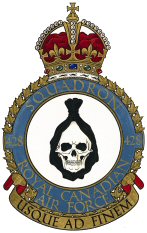
428 (Ghost) Squadron Lancaster X KB759 NA-K F/O. Parsons
Operation: Hamburg
Date: 28/29 July 1944 (Friday/Saturday)
Unit: No. 428 (Ghost) Squadron RCAF, No. 6 Group
Type: Avro Lancaster X
Serial: KB759
Code: NA-K
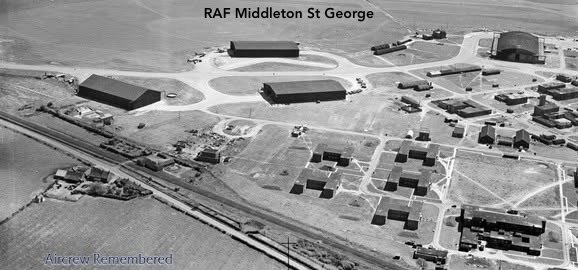
Base: RAF Middleton St George, Durham, England
Location: North Sea, off Heligoland
Pilot: F/O. Reginald Parsons, J/29191, RCAF, Age 20 - Missing, believed killed
2nd Pilot: P/O. Thomas Eldon Magill, J/85833, RCAF, Age 26 - Missing, believed killed
Fl/Eng: P/O. Arthur Ernest Attewell, C/87994, RCAF, Age 22 - Missing, believed killed
Nav: P/O. James Arthur Urquhart, J/86471, RCAF, Age 20 - Missing, believed killed
Air/Bmr: P/O. Thomas Graham Murdoch, J/87750, RCAF, Age 21 - Missing, believed killed
W/Op/Air/Gnr: Fl/Lt. Bertram Leonard Smith, 117761, RAFVR, Age 26 - Missing, believed killed
Air/Gnr: P/O. Hugh Alexander Adams, J/87993, RCAF, Age 23 - Missing, believed killed
Air/Gnr: P/O. Francis Bruce Thaine, J/87995, RCAF, Age 19 - Missing, believed killed
Reason for Loss
On the night of 28/29 July 1944, RAF Bomber Command mounted a raid on Hamburg. No. 428 Squadron contributed Lancaster Xs as part of a No. 6 Group force of 46 Lancasters (Nos. 408, 419 and 428 Squadrons) and 186 Halifaxes drawn from twelve other 6 Group squadrons. Bombing was carried out from 16,000-22,000 feet, and the attack was scattered rather than concentrated. It proved to be 6 Group's worst night of the war for losses, with 22 crews failing to return.
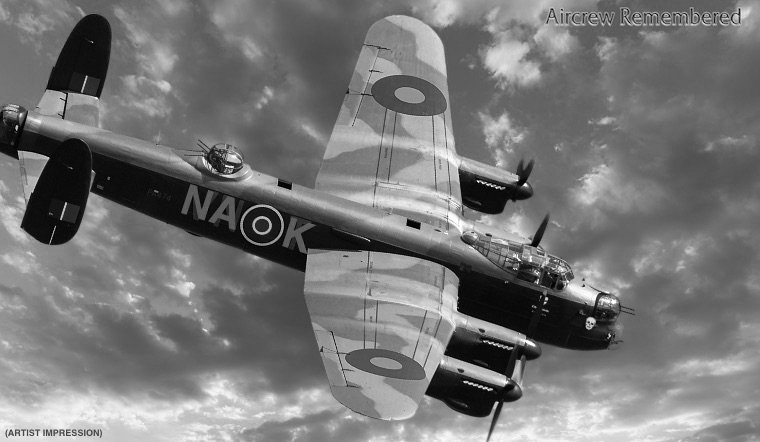
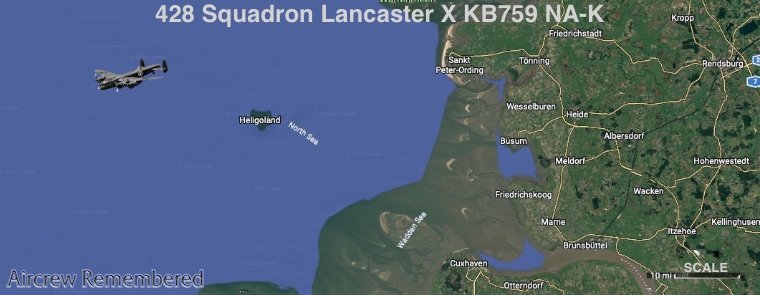 428 Squadron's Lancaster X KB759 (code NA-K) bombed Hamburg and was on the return leg when it was shot down by a German night fighter, crashing into the North Sea off Heligoland. All eight crew were listed as missing; none has a known grave, and they are commemorated on the Runnymede Memorial. It was the squadron's only loss that night, and the aircraft had been with the squadron for barely three weeks.
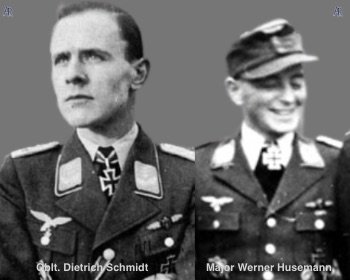
Possible night-fighter claimants were the crew of Oberleutnant Schmidt, Feldwebel Schönfeld and Feldwebel Schlosser of 8./NJG 1, who had taken off from Twente airfield in the Netherlands at 00:21 hrs flying a Bf 110 G-4 (G9+AS); or the crew of Major Werner Husemann of Stab I./NJG 3, who had taken off from Vechta airfield, Niedersachsen, flying a Ju 88 G-6 (D5+XB). (pilots shown left)
 Burial Details
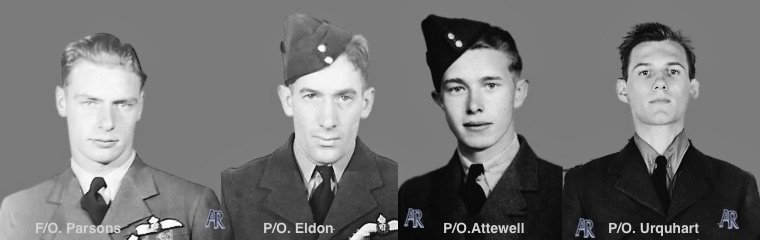 F/O. Reginald Parsons. Runnymede Memorial. Panel 247. Son of George William Parsons (died 1949, age 64) and Margaret Isabel Parsons (née Gray, later Casmey - died 1989, age 99), of Carrying Place, Ontario, Canada. Born 21 June 1924 in Timmins, Ontario, Canada.
P/O. Thomas Eldon Magill. Runnymede Memorial. Panel 251. Son of Thomas Henry Magill (died 1943, age 65) and Sarah Ella Magill (née Wyant - died 1975, age 90), of Garson, Ontario, Canada. Born 23 January 1918 in Sault Ste. Marie, Ontario, Canada.
P/O. Arthur Ernest Attewell. Runnymede Memorial. Panel 249. Son of Wing Commander William Gordon Attewell, C/8185, MBE, RCAF, and Gladys Ethel Attewell, of Toronto, Ontario, Canada. Born 15 July 1922 in Toronto, Ontario, Canada. (see note below on his father)
P/O. James Arthur Urquhart. Runnymede Memorial. Panel 253. Son of Robert Edmond and Camelia Urquhart, of Montreal, Canada. Born 16 October 1923 in Montréal, Québec, Canada.
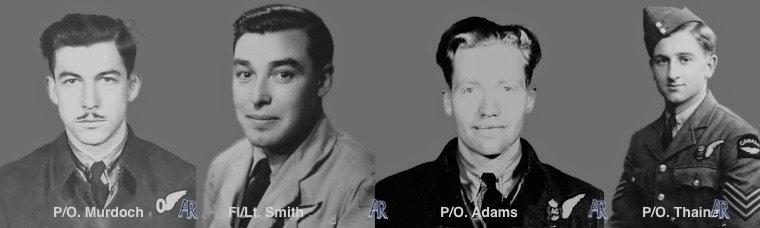 P/O. Thomas Graham Murdoch. Runnymede Memprial. Panel 251. Son of Thomas Henry and Sarah Ella Magill, of Garson, Ontario, Canada. Born on the 12th February 1923 in Orillia, Ontario, Canada
Fl/Lt. Bertram Leonard Smith. Runnymede Memorial. Panel 203. Son of Louis Thomas Smith and Rose Smith (née Maltby), of Barking, Essex. Husband of Bertha Nellie Smith (née Gardner). Born 11 June 1918 in the London Borough of Barking and Dagenham, England.
P/O. Hugh Alexander Adams. Runnymede Memorial. Panel 249. Son of William Adams (died 1946, age 73) and Agnes Annie Adams (née McHarg - died 1960, age 79). Husband of Eunice F. Adams, of Springside, Saskatchewan, Canada. Born 28 September 1920 in Saskatchewan, Canada.
P/O. Francis Bruce Thaine. Runnymede Memorial. Panel 251. Son of Percy Victor and Margaret Mary Maud Thaine (née Robinson), of Northallerton, Yorkshire. Born 25 September 1924 in Crewe, Cheshire, England.
Notes
RAF Middleton St George
The airfield was a Bomber Command station used jointly by the Royal Air Force and the Royal Canadian Air Force during the Second World War, situated in County Durham roughly six miles east of Darlington. Its motto, 'Shield and Deter,' reflected its wartime purpose. Today the site continues to operate as Teesside International Airport.
The station was approved for construction in 1938 as Britain prepared for the coming conflict, and it became operational in 1941 under Bomber Command. Despite a persistent local myth, the base was never officially named 'RAF Goosepool' - that name belonged to the farmland the airfield replaced, and it simply stuck as an informal nickname among nearby residents.
The first squadrons stationed there were No. 76 Squadron, flying Handley Page Halifaxes, and No. 78 Squadron, operating Armstrong Whitworth Whitleys.
By 1943, control of the airfield passed to No. 6 Group of the Royal Canadian Air Force. RAF Croft served as a satellite station, though RAF Thornaby, despite being nearer, never received that designation. Canadian units based at Middleton St George included No. 419 'Moose' Squadron (Wellingtons, Halifaxes and Lancasters), No. 420 'Snowy Owl' Squadron (Wellingtons), and No. 428 'Ghost' Squadron (Wellingtons, Halifaxes and Lancasters).
Acts of Heroism
Two notable stories of bravery are tied to the station. The best known involves Andrew Mynarski of No. 419 Squadron, who received a posthumous Victoria Cross for his actions during a 13 June 1944 bombing raid on Cambrai, France, carried out in support of the Normandy invasion. A statue honouring him was unveiled in 2005 near the site of the former Officers' Mess.
The second story concerns William McMullen of No. 428 Squadron, who died on 13 January 1945 during a training flight. When his Lancaster went down near Darlington, he stayed at the controls to steer the aircraft clear of nearby houses after ordering the rest of his crew to parachute out. A nearby road, McMullen Road, was later named in his memory. A memorial garden honouring all aircrew who served at the station now stands close to the former Mess building.
Postwar Years
Following the war, control of the airfield shifted repeatedly among Bomber, Fighter and Flying Training Commands, hosting a variety of units and aircraft over the years - among them No. 13 Operational Training Unit flying Mosquitos, No. 2 Air Navigation School with Ansons and Wellingtons, and No. 205 Advanced Flying Training School (later No. 4 Flying Training School) operating Vampires and Meteors. Other tenants included No. 92 Squadron with Hawker Hunters, No. 264 Squadron (later No. 33 Squadron) with Meteors, the Javelin Instrument Rating Squadron flying Gloster Javelins, and the Lightning Conversion Unit operating English Electric Lightnings. The latter two eventually merged into No. 226 Operational Conversion Unit.
In September 1962, Flying Officer Jean Oakes made history as the first woman to exceed 1,000 mph in flight. According to a Times report from that month, she took the controls of a Lightning jet from Flight Lieutenant John Smith at 35,000 feet over the North Sea and flew along the northeast coastline at roughly Mach 1.6.
Transition to Civilian Use
The RAF withdrew from the site in 1964, transferring it to the Ministry of Civil Aviation, which converted it into a commercial airport. It operated under the name Tees-Side Airport until 1987, then as Teesside International Airport until 2004, when it was renamed Durham Tees Valley Airport. The airport reverted to its Teesside International name in 2019.
Between 1968 and 1979, several of the original station buildings were repurposed to house Middleton St George College of Education, a teacher-training institution.
The former Officers' Mess later became the St. George Hotel, which included a memorial room dedicated to the RAF station's history. The hotel closed in late 2018, and there are plans to relocate its museum collection.
The Sergeants' Mess is still in active use today by Serco, which runs the International Fire Training Centre on the site, while the old Armoury building now houses a flying school along with Scenic Air Tours and Flight Training.
 RUNNYMEDE Memorial
The Memorial (formally the Air Forces Memorial) sits on Cooper's Hill at Englefield Green, near Egham, Surrey, overlooking the Thames between Windsor and Egham on the A308. It is a Commonwealth War Graves Commission site commemorating over 20,000 airmen and airwomen of the Commonwealth air forces who died in the Second World War operating from bases in the United Kingdom and North and Western Europe and who have no known grave - it is specifically for the missing, not burials. It covers Bomber, Fighter, Coastal, Transport, Flying Training and Maintenance Commands.
It was designed by Sir Edward Maufe, with sculpture by Vernon Hill and engraved glass and ceiling work by John Hutton, built around a tower evoking a wartime airfield control tower. Queen Elizabeth II unveiled it on 17 October 1953, her first official visit to a CWGC site as monarch.
It is open to visitors daily: weekdays 9am-6pm (or dusk if earlier), weekends and holidays 10 am-6pm (or dusk if earlier).
WING COMMANDER WILLIAM GORDON ATTEWELL, MBE, RCAF
His full name was William Gordon Attewell (service number C8185), not "William George" as sometimes rendered in shorter records.
Early life and WWI service: He was born in Bath, England, on 10 January 1899, and emigrated to Canada in January 1914. He joined the Canadian Militia and then the Canadian Expeditionary Force, going overseas in early 1916. He was severely wounded at Courcelette in September 1916, repatriated to Canada, and discharged in August 1918.
Interwar RCAF career: He joined the staff of the Canadian Air Board in 1922 as an air mechanic at Camp Borden, then formally enlisted in the Permanent RCAF on 1 April 1924. He spent much of his career around Ottawa before being posted to Winnipeg in 1934.
Second World War: He reached Warrant Officer First Class rank in late 1939, and was sent to England with the RCAF in January 1940, with special responsibility for No. 110 Squadron's equipment; he was also involved in shipping BCATP (British Commonwealth Air Training Plan) equipment between the UK and Canada. He was commissioned as an officer in 1940, promoted to Flight Lieutenant on 7 May 1942, and later to Squadron Leader and then Wing Commander. He spent the rest of the war at RCAF Overseas Headquarters in London.
The MBE: He was appointed a Member of the Order of the British Empire, gazetted effective 14 June 1945. His citation praised long, steady administrative service rather than a single act - the record notes that "as officer commanding the administration unit of this headquarters for nearly three years, his capable leadership and direction have been reflected in the smooth and efficient operation of his unit," adding that his "drive and persistent efforts have been an inspiration to the personnel under his command."
Family: He and his wife Gladys Ethel Attewell lived in Toronto. Their son, Arthur Ernest Attewell, followed him into the RCAF as a Flight Engineer.
Sources and Acknowledgements
- Kracker Luftwaffe Archive
- National Archives, Kew
- 428 (Ghost) Squadron ORB
- Aircrew Remembered Archives
- Paradie-Dutill RCAF Archives
- Runnymede Memorial Database
- RAF Commands Forum
- Commonwealth Graves Commission





