
- Home
- Maps▾
- FAQ▾
- About/Donate▾
- News▾
- Obits
- Contact/Help▾
- PersonalHistories▾
- Cross Reference Research Lists ▶
- Recent Archive Reports
- Profiles in Courage
- 1914 -1918 WW1 Material
- Royal Air Force + RAFVR ▶
- WAAF/WRAF
- Australia
- Belgium
- Canada
- Site honouring Czechoslovak RAF
- Holland: LOST Rob Philips Memorial Archive
- New Zealand
- Norway, Denmark, Sweden, Finland
- Poland
- South Africa
- Archiwum Mielnika: Polish Air Force Archive
- USAAF & USAF
- USA WASP Flygirls
- USA - Co de Swart Gallery: Baker Crew 95th BG
- USA - Co de Swart Gallery: Geyer Crew 98th BG
- Axis Powers
- Russia/Soviet Union
- RCAF 409 The Nighthawks
- Hore-Kennard RCAF
- Zenon Bartkowiak PAF
- Charles Dills USAAC
- Gerald Schwartz USAAC
- Ralph Malan Memoirs
- Soviet Women 'Night Witches'
- Full Story of Lancaster Z-Zebra
- First Air Raid Victim
- 1914 -1918 WW1 Material
- Databases▾
- Databases Master List
- Consolidated Names: includes 500K+ names from all our databases
- Cross Reference Research Lists
- Research Sources
- MULTI-NATIONAL DATABASES
- Aces and Aviators International WW1 - 3000+
- Vitz Archive: War Crimes Victims of Axis
- NEW! USAAF & Allies Non Combat Incidents and Losses
- ALLIED DATABASES
- Allied Losses and Incidents: all Commands
- Aircrew Deaths & Resting Places Worldwide 1939 - 47 120,000+
- Alamein Allied Air Forces Memorial 3000+
- Allied Non-British Graves in Europe managed by CWGC
- Battle of Britain: Enhanced and Extended
- Glider Pilot Regiment Casualties
- Korean War UN Forces Database
- LOST Rob Philips Memorial Archive Dutch/2TAF Losses
- Malta Memorial Database
- Nordic Allied Database
- Ottawa Allied Air Forces Memorial Database
- Paradie RCAF Archive
- Archiwum: Polish Air Force Archive
- Polish Honour Roll
- RAAF Honour Roll
- RCAF Notes - 9000+
- Royal Navy Fleet Air Arm
- Runnymede Memorial Database
- Soviet Aces Database 1941 - 1945
- US Aces and Aviators WW2
- US Air Service Victories WW1
- USAAF Allies NonCombat Losses
- USAAF Operations WWll
- US Marine Corps Squadrons WWll
- Vitz Memorial Archive: War Crimes Victims of Axis
- AXIS DATABASES
- Kracker Luftwaffe Archive
- Deutsches Kreuz in Gold
- German Graves in UK
- German WW2 Aces
- Luftwaffe Graves Managed by CWGC
- Luftwaffe Victories by Name/Date
- Archives ▾
- Archiwum: Polish Air Force Archive: Data on 17,000
- Kracker Luftwaffe Archive
- LOST Rob Philips Memorial Archive: Holland
- Paradie Canadian Archive
- Paul McGuiness RAAF Archive WW1 & WW2
- Profiles in Courage
- Vitz Memorial Archive: War Crimes Victims of Axis
- USAAF Combat Operations 1941-45 Worldwide
- 409 RCAF: The Nighthawks
- Detailed Personal Archive RCAF Officer
- Charles Dills Archive
- Gerald Schwartz Archive
- Ralph Malan Memoirs
- RAF Coastal Command Patrol Areas
- US Intelligence Analysis German Anti Aircraft
- Allied Mine Laying Map (Gardening)
- Airborne Forces - a short history
- More ▾
- de Swart Gallery: Baker Crew, Geyer Crew
- Guide to Complete Site
- Helpdesk
- Donate
- Lay a Wreath
- Your relative's CWGC grave explained
- CWGC War Graves in USA
- Doing Your Own Research
- Research Sources
- US Assistance to Warsaw Uprising
- Our support for charities
- Axis Awards Descriptions
- Stolperstein: Permanent Remembrance
- Who fought for Britain 1939 - 1945
- Aerotoxic Syndrome
- Bermuda Triangle Mystery
- Cross Reference Research Lists
- Not Many People Know That
- Image Acknowledgements
- Abbreviations Used by Forces
- Poetry of Direct Personal Experience
- Staggering Cost in Lives of WWll
- Animated Map All Allied Bombing WW2
- USAAF Combat Operations 1941-45 Worldwide
- Polish Airmen Fighting (Video)
- Important Links
- Canada Memorial Project
- Remembering Banica
- Book Reviews
- 1 BFTS Texas
- Veterans Appeals
- Korean Conflict
- Vietnam Conflict
- Other Conflicts
- Commercial Aviation
- Bush Flying
- Nose Art
- Military Humour
- Airborne Forces - a short history
-

Aces and Aviators International Database WW1
Check the Databases Menu for the extensive list of our databases which represent decades of original research by our Editors
Data derived from many sources. Corrections/Additions requested through Helpdesk
Search Tips • Researchers • Check Spelling Names • USAS Airservice Database • Databases On Site
As Defence Journal describes it, at the outbreak of the First World War (WW1) in 1914, military aviation consisted of light wooden bi/tri planes with maximum speeds of under 100 mph and very limited load carrying capacity.
Their roles were initially restricted to reconnaissance and artillery observations.
While there may not have been any air power doctrine on the eve of WW1, there was no shortage of alarming speculations about strikes from the sky, thanks to pre-war novels from H.G Wells and others.
Within seven weeks of WW1 beginning, Sopwith Tabloids of Britain's Royal Naval Air Service conducted an air raid on the Zeppelin (airship) sheds in Germany. A year later Germany retaliated when Zeppelins in turn bombed English cities.
The actual damage in all these raids may have been minimal but the psychological impact on civilians and populations was profound.
With both sides using increasing numbers of aircraft for reconnaissance, artillery observations and occasional bombing raids, the inevitable happened and aircraft started to shoot at each other to prevent the adversary from taking military advantage of the new medium. This marked the birth of fighter aircraft whose numbers proliferated whilst their performance took a quantum leap. The battle for control of the air had truly begun. The writing was clearly on the wall for military tactics and precepts that had stood for hundreds of years as the full flower of air power's potential to change the course of events and even win wars had to be acknowledged.
The Air War assumed a giant scale on both sides. By way of example, the British had upwards of 2,000 planes active by war end. And the war saw many tactics and strategies develop that were further developed in the Second World War.
Recovering names and details from over 100 years ago is a big task. If you have additions or corrections, or know of places we can contact to request their data, please let us know via the Helpdesk.
Searching here is powerful. Check the Search Tips first. You can search on single items (a surname for example, or a country) and you can search on combinations: thus a search on 'Australia and Camel' will find all records where BOTH Australia and Camel are mentioned.
You can search on 2 characters or more
Searching is possible on French squadrons, but with some care. The French named their squadrons for the plane each flew, thus N95 was a squadron flying Nieuport, SPA 150 flew the SPAD. To search for squadron N95 search for 'Nieuport N95'. Squadrons flying the Caudron were designated C50 for example, so in this case search for 'Caudron C50'.
Be aware we have used dozens of different sources. Some use special characters (such as umluats on German), others use Anglicized versions of the word. Thus some use Göring, and some use Goering. Try different approaches.
Countries/Nationalities Included: Agentina, Australia, Austro-Hungarian Empire, Austria, Belgium, Bermuda, Bulgaria, Canada, Canada Newfoundland, Canada French Canada, Chile, China, Czechoslovakia, Denmark, Estonia, Fiji, Finland, France, Georgia, Germany, Germany Bavaria, Germany Sudetenland, Great Britain (Wales, Scotland, Ireland separately listed), Greece, Guatemala, Hungary, India, Italy, Jamaica, Japan, Latvia, Lithuania, Mauritius, Mexico, Netherlands, Slovakia, Hungary, Australia, New Zealand, Norway, Poland, Portugal, Romania, Russia, Serbia, Slovakia, Swaziland, Switzerland, Turkey Ottoman Empire, USA, Venezuela, Vietnam.
The reader is referred to a site of great scholarship on WWl aviation. airhistory.org is comprehensive and valuable.
Refer to Paul McGuiness RAAF Archive WW1This page has opened with a sample Search for demonstration purposes.
Searches are now permitted on 2 character minimum (previously 3).
To search on single digit Squadron append Sqd, thus: search on '5 Sqd'
These are the results of your search:
You searched for: “White, James Butler”
| # | Name* SORT (↓) | First Names | Rank | Awards | Country SORT (↓) | Alliance | Role | Victories | Details | Units | Air Service | Death | Notes/Aircraft | Sources | Links | Photo |
|---|---|---|---|---|---|---|---|---|---|---|---|---|---|---|---|---|
| 1 | McCloughry (later McClaughry) | Wilfred Ashton | DSO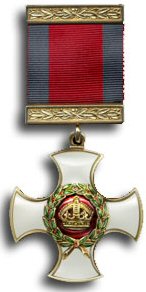 MC 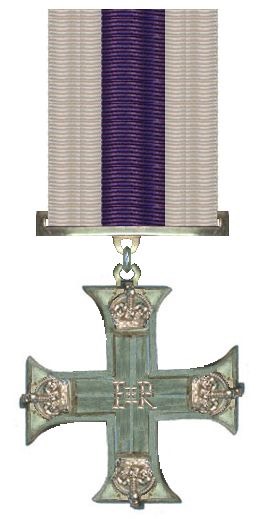 DFC  MiD (x3)  | Australia | Allies | Pilot | 3 | 4 Sqn | Australian Flying Corps | 1943 | Wilfred Ashton McCloughry (1894-1943) and Edgar James McCloughry (1896-1972), airmen, were the first and second sons of James Kingston McCloughry from Larne, Northern Ireland, and his Australian-born wife Charlotte Rebecca Ashton. Wilfred was born on 26 November 1894 at Knightsbridge, Adelaide, and Edgar on 10 September 1896 at Hindmarsh. Wilfred later changed his surname to McClaughry and Edgar became Kingston-McCloughry. Wilfred was educated at Queen's School, North Adelaide, University of Adelaide and the Adelaide School of Mines. Commissioned into the Australian Military Forces in 1913, he transferred to the Australian Imperial Force in 1914 and went overseas with the 9th Light Horse Regiment. On Gallipoli from May to August 1915 he was wounded twice. Seconded to the Royal Flying Corps in March 1916, after flying training he served in a home defence squadron operating against German airships. He joined No.100 Squadron, the R.F.C.'s first night bomber unit, on its formation and in March 1917 accompanied it to France as a flight commander. He was awarded the Military Cross in July. One of the experienced Australians in the R.F.C. selected to strengthen the expanding Australian Flying Corps, Wilfred joined the Second Squadron and accompanied it to France as a flight commander in September 1917. In October he was recalled to England to command the Fourth Squadron and took that overseas in December. Quiet but firm, he led one of the most efficient Sopwith Camel squadrons on the Western Front in 1918. He flew frequent daylight missions and undertook several risky night sorties against enemy heavy bombers in Camels not equipped for night flying. Credited with three victories, he was awarded the Distinguished Flying Cross and the Distinguished Service Order and was mentioned in dispatches three times. During the battle of Britain Wilfred commanded No.9 Fighter Group and in 1942, appointed C.B. and air vice marshal, became Air Officer Commanding, Egypt. Died Accidental (air crash), Heliopolis, Egypt, 4 January 1943, aged 48 years. Buried Heliopolis War Cemetery | Bio |   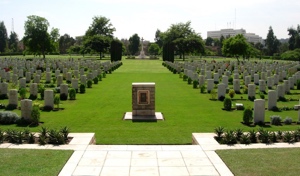 Heliopolis |
|||
| 2 | Edwards | Herbert James | Capt | Australia | Allies | Pilot | 5 | [2+3] (4 kills+1 Lost Control) | 32Sqn, 92Sqn | RFC | DH5 ace, 1917. | Shores |  |
|||
| 3 | Thompson | Claud Robert James | Lt | Australia | Allies | Pilot | 6 | [5+1] (2 kills+4 Lost Control) | 19Sqn | RFC | 17/07/1918 | Spad ace, 1917. KIFA. | Shores | |
||
| 4 | Smith | Ross McPherson 'Hadji' (Sir) | Capt | Knight Commander of the Order of the British Empire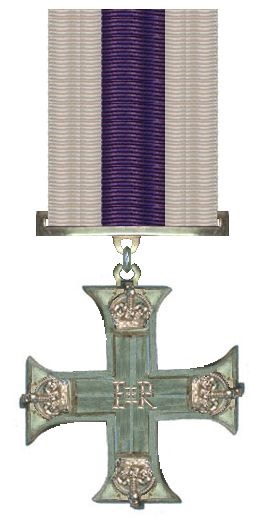 Military Cross & Bar 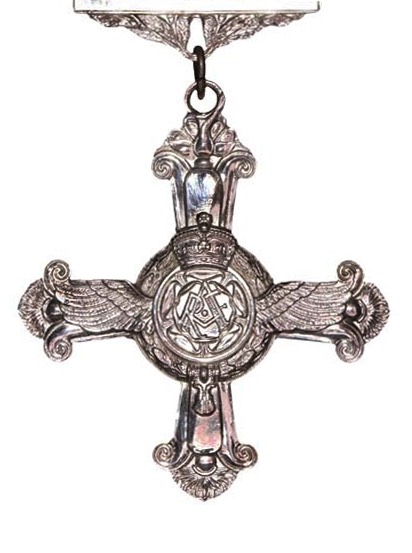 Distinguished Flying Cross & Two Bars Distinguished Flying Cross & Two Bars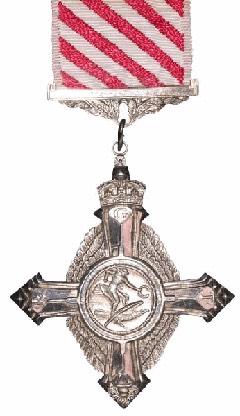 AFC AFC | Australia | Allies | Pilot 2 Seater | 10 | (10 kills+1 Lost Control) | 67 Sqn, 1 Australian Flying Corps Sqn | Australian Flying Corps | 14/04/1922 | BE12, F2B ace, Palestine, 1917-18. KIFA. Australian aviator and WWI pilot ace, Ross MacPherson "Hadji" Smith was born 4/12 1892. Sir Ross Macpherson Smith, KBE, MC & Bar, DFC & Two Bars, AFC (4 December 1892 – 13 April 1922) was an Australian aviator. He and his brother, Sir Keith Macpherson Smith, were the first pilots to fly from England to Australia, in 1919. Smith enlisted in 1914 in the 3rd Light Horse Regiment, landing at Gallipoli 13 May 1915. In 1917, he volunteered for the Australian Flying Corps. He was later twice awarded the Military Cross and the Distinguished Flying Cross three times, becoming an air ace with 11 confirmed aerial victories. With Ernest Mustard in their Bristol Fighter in Palestine, 1918. Smith was pilot for T. E. Lawrence (Lawrence of Arabia) and fought in aerial combat missions in the Middle East. He is mentioned several times in Lawrence's book, Seven Pillars of Wisdom, Chapter 114. Smith and his brother Keith, Sergeant James Mallett (Jim) Bennett and Sergeant Wally Shiers, flew from Hounslow Heath Aerodrome, England on 12 November 1919 in a Vickers Vimy, eventually landing in Darwin Australia on 10 December, taking less than 28 days, with actual flying time of 135 hours. The four men shared the £10,000 prize money put forward by the Australian government. Smith was killed (along with the recently commissioned Lieutenant Bennett) while testing a Vickers Viking amphibian aircraft which crashed in Byfleet soon after taking off from Brooklands on 13 April 1922. Captain Stanley Cockerell, test pilot for Vickers, had flown Smith and Bennett as passengers on the aircraft's maiden flight earlier that day and testified to the inquest that the machine seemed to be in perfect working order. The jury returned a verdict of death by misadventure.[3] The bodies were transported to Australia and Smith was given a state funeral and later buried on 15 June at the North Road Cemetery, Adelaide. The Australian cricketer Keith Ross Miller was named after Smith and his brother. | Shores. |   |
|
| 5 | Traill | James H. | Lt | Australia | Allies | Observer | 6 | (5 kills+1 Lost Control) | 1Sqn (gunner) | Australian Flying Corps | Bristol Fighter gunner, 1918. | Franks-Guest | |
|||
| 6 | Weir | William James Alexander | Lt | Australia | Allies | Observer | 6 | [4+2] (5 kills+1 Lost Control) | 1Sqn (gunner) | Australian Flying Corps | Bristol Fighter gunner, 1918. | Franks-Guest (5 Shores) | |
|||
| 7 | Wellwood | James Joseph | Lt | Australia | Allies | Pilot | 7 | (5 kills+2 Lost Control) | 2 AFC Sqn | Australian Flying Corps | SE5 ace, 1918. | Shores | |
|||
| 8 | Brownell | Raymond James 'Brownie' | Capt | CBE MC MM | Australia | Allies | Pilot | 12 | [8+4] (1 balloon)(9 kills+3 Lost Control) | 45Sqn | RFC & RAF | 1974-04-02, aged 79, Subiaco West Australia | Camel ace, 1917-18, Italian front. He served as a gunner in Gallipoli, the Western Front and the battles of both the Somme and Pozieres. Whilst serving as a Sergeant with the 5th Battery, 3rd Field Artillery Brigade he was awarded the Military Medal and promoted to Second Lieutenant. Discharged on 16th March 1917 he transferred to the Royal Flying Corps (RFC), one of 200 Australians recruited by the RFC, at the same rank. He was transferred to 45 Squadron on completion of training, where he shot down five enemy aircraft over France before the squadron was transferred to Italy in November 1917. Seven more kills occurred in Italy, notably that of the German Ace, Alwin Thurm on the 31st December 1917, which he shared with Henry Moody. On the 4th March 1918 Raymond Brownwell was awarded the Military Cross MC Citation: “2nd Lt. Raymond James Brownell MM Military Cross For conspicuous gallantry and devotion to duty. Within the last three months he has brought down six enemy aeroplanes, four of which were seen to come down in flames, the other two falling completely out of control. The dash, gallantry and offensive spirit displayed on all occasions by this officer are worthy of the highest praise.” Raymond James Brownell’s Victories 45Sqn Sopwith Camel 10 Sep 1917 1720 in B2323 DFW Houthoulst Wood 20 Sep 1917 1825 Shared with Henry Moody and Emerson Smith, Paschendaele 01 Oct 1917 1220 in B2323 Albatross DV, Quesnoy 20 Oct 1917 1240 Albatross DV, Kastelhoek 27 Oct 1917 1015 Albatross DV shared with James Child and Matthew Frew, NE of Comines 31 Dec 1917 0945 in B2430 Albatross Dlll, Piave de Soligo 31 Dec 1917 1030 in B2430 Albatross DV shared with Henry Moody, Paderno 10 Jan 1918 1615 in B2430 Albatross Dlll, Portobuffolo 11 Jan 1918 1535 in B2430 Albatross Dlll, St. Stino 30 Jan 1918 1045 in B6283 DFW, Saleto 17 Apr 1918 0915 in B3872 Albatross Dlll Oderzo 18 Apr 1918 in B3872 Balloon, Piave River Following World War 1, Brownwell returned to Australia, joining the Royal Australian Air Force serving with Number 1 Squadron from 1926 to 1928 and at RAAF Base Pearce (No 23 City of Perth Squadron) between 1938 and 1940. He further served in the following capacities during World War 2. • Wing Commander commanding RAAF Base 'Pearce', Western Australia, in 1939 • Commanded RAAF. units in the Far East 1940-1941. RAF Sembawang (1940–41) • Air Officer Commanding (AOC) 1 Training Group 1941-1942 • Promoted to Air Commodore and was (AOC) Western Area 1943-1945 • Appointed CBE on 01 January 1945 • Placed in command of No.11 Group, Morotai, on 30 July 1945 – 1946 | Shores/Tasman Aviation Historical | Tasman Aviation Historical |  |
| 9 | Goble | Stanley James | Maj | Australia | Allies | Pilot | 10 | (4 kills+6 Lost Control) | 1Wg,8Sqn, 5Sqn RNAS; 205Sqn RAF | RNAS & RAF | Nieuport, Pup, 1916; DH-4, 1918. | Shores |  |
|||
| 10 | McCloughry (later Kingston-McCloughry) | Edgar James Kingston | Capt | DSO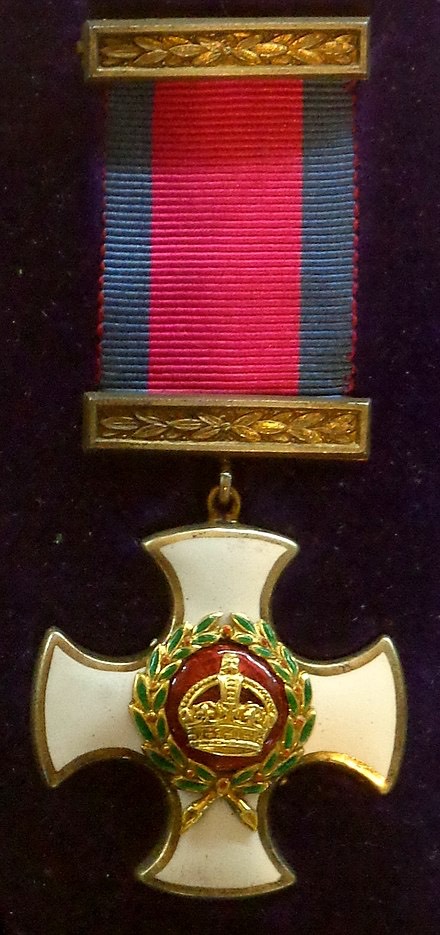 DFC & Bar MiD 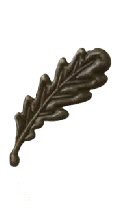 Australia | Allies | Pilot | 21 | (4 balloons)(20 kills+1 Lost Control) | 23 Sqn RFC; 4 Sqn AFC (CO) | RFC & AFC | 15 November 1972 | Camel ace, 1918. Australian WWI fighter ace, Edgar James Kingston McCloughry was born 10/9 1896. He authored 2 books: Direction of War
A Critique of the Political Direction and High Command in War; E.J. Kingston McCloughry / Hardcover / New York: Frederick A. Praeger, 1958
Defense Policy and Strategy
E.J. Kingston McCloughry / Hardcover / New York: Frederick A. Praeger, 1960 More: http://www.theaerodrome.com/aces/australi/mccloughry.php | Citation DFC: Lieut. (T./Capt.) Edgar James McClaughry (Australian Flying Corps). Early one morning this officer left the ground, and, meeting an enemy two-seater ten miles over the lines, he engaged and destroyed it. He was immediately attacked by five scouts; these he out-manoeuvred, destroying one and driving the remainder down. He is a determined and successful scout leader, who in recent operations has accounted for nine enemy machines, in addition to three others and one balloon when serving with another squadron. Citation DFC Bar: Lt. (T./Capt.) Edgar James McClaughry, D.F.C. (Australian Flying Corps). In the short space of one month this officer has destroyed ten enemy aeroplanes and balloons. He has organised and carried out numerous raids on the enemy, frequently at very low altitudes. Altogether he has destroyed fifteen aeroplanes and four balloons. Early one morning he crossed our lines to attack a balloon which he had previously located. As soon as daylight allowed he dived and opened fire on the balloon, which was on the ground, descending to within fifty feet of it. The balloon burst into flames. He then attacked some horse transport, dropping bombs and firing, some 300 rounds at 1,500 feet altitude. Citation DSO: Capt. Edgar James McClaughry, D.F.C. (Australian F.C.). (FRANCE) A bold and fearless officer, who has performed many gallant deeds of daring, notably on 24th September, when, attacking a train at 250 feet altitude, he obtained a direct hit, cutting it in two, the rear portion being derailed. He then fired a number of rounds at the fore portion, which pulled up. Sighting a hostile two-seater he engaged it and drove it down. Proceeding home he observed seven Fokker biplanes; although he had expended the greater part of his ammunition, Captain McClaughry never hesitated, but engaged the leader. During the combat that ensued he was severely wounded by fire from a scout that attacked him from behind; turning, he drove this machine off badly damaged. His ammunition being now expended he endeavoured to drive off two hostile scouts by firing Very lights at them. Exhausted by his exertions, he temporarily lost consciousness, but recovered sufficiently to land his machine safely. This officer has destroyed fourteen machines and four balloons, and has repeatedly displayed an utter disregard for danger in attacking ground targets. Later changed name to Kingston-McCloughry. Brother of Wilfred Ashton McCloughry who changed his name to McClaughry Shores (Other sources 23) | Bio |  | |
| 11 | Coppens de Houthulst | Willy Omer Franois | Lt |  Order of Leopold II  Order of the Crown 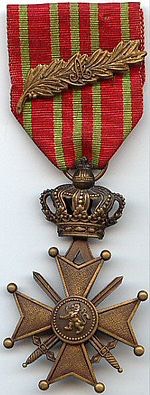 Belgian Croix de Guerre  French Legion d'Honneur  Serbian Order of the White Eagle British Distinguished Service Order British Military Cross 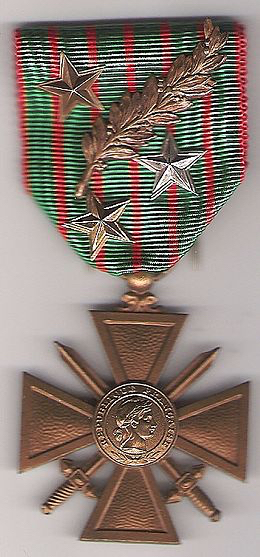 French Croix de Guerre | Belgium | Allies | Pilot | 37 | (35 balloons)(+ 5 unofficial.) | Esc6, Esc4, Esc1, Esc9 | Aviation Militaire Belge | Hanriot Drachen killer, 1918. Date Of Birth: July 6, 1892 Place of Birth: Watermaal-Bosvoorde Date Of Death: December 21, 1986 | Franks-Guest | (1) Belgian Air Force (2) Story |    |
|
| 12 | Glen | James Alpheus | Capt | Canada | Allies | Pilot | 15 | [5+10] (9 kills+6 Lost Control) | 3(N)Sqn, 203Sqn | RNAS & RAF | Pup and Camel ace, 1917-18. | Shores | |
|||
| 13 | Forman | James Henry | Capt | Canada | Allies | Pilot | 9 | [7+2] (4 kills+5 Lost Control) | 6(N)Sqn, 1(N)Sqn, 201Sqn, 70Sqn | RNAS & RAF | Camel ace, 1917-18. POW. | Shores | |
|||
| 14 | Salter | Ernest James | Capt | Canada | Allies | Pilot | 9 | [8+1] (4 kills+5 Lost Control) | 54Sqn | RAF | Camel ace, 1918. | Shores | |
|||
| 15 | James | Mansell Richard | Capt | Canada | Allies | Pilot | 11 | (9 kills+2 Lost Control) | 45Sqn | RAF | 28/05/1919 | Camel ace, 1918. MIFA. | Shores | |
||
| 16 | Smith | James Robert | 2ndLt | Canada | Allies | Observer | 5 | (2 kills+3 Lost Control) | 18Sqn (observer) | RFC | FE2b gunner ace, 1916-17. | Franks-Guest | |
|||
| 17 | Smith | James Robert | 2ndLt | Canada | Allies | Observer | 5 | (2 kills+3 Lost Control) | 18Sqn (observer) | RFC | FE2b gunner ace, 1916-17. | Franks-Guest | |
|||
| 18 | Duncan | William James Arthur | Capt | Canada | Allies | Pilot | 11 | [6+5] (9 kills+2 Lost Control) | 60Sqn | RFC & RAF | SE5 ace, 1917-18. | Shores | |
|||
| 19 | White | Joseph Leonard Maries | Capt | DFC and Bar Belgium Croix de Guerre 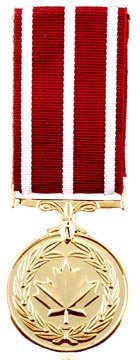 Medal for Military Valour | Canada | Allies | Pilot | 22 | [20+2] (12 kills+10 Lost Control) | 65 Sqn | RAF | 1925-02-24 | 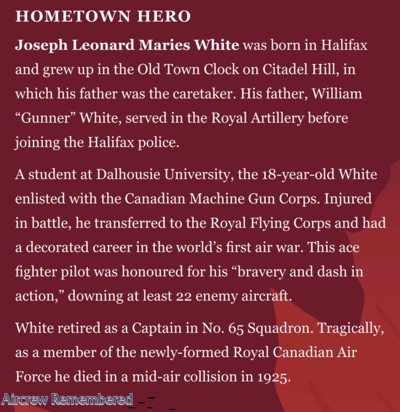 Camel ace, 1918. KIFA. Citation: DFC 'Lt. Joseph Leonard Maries White (late Canadian Machine Gun Corps). This officer is distinguished for his bravery and dash in action, never hesitating to attack, regardless of the enemy's numerical superiority. He has destroyed three enemy aircraft and driven down two out of control. In addition he has carried out most valuable reconnaissance service at low altitudes.' Citation: DFC - Bar 'Lt. (T./Capt.) Joseph Leonard Maries White, DFC (Can. M.G.C.). In company with another pilot this officer recently attacked a hostile formation of fourteen scouts. One of these he shot down in flames, and a second out of control. Captain White not only displays courage and skill of a high order in attacking machines in the air and troops on the ground, but he has rendered excellent service on reconnaissance duty, obtaining most valuable information.' (Photo courtesy François Dutil) | Shores (Other sources 31) |  |
|
| 20 | White | James Butler | Capt | Canada | Allies | Pilot | 12 | [10+2] (7 kills+5 Lost Control) | 8Sqn, 208Sqn | RNAS & RAF | Camel ace, 1918. | Shores | |
|||
| 21 | Dell'Oro | Arturo |  Gold Medal for Military Valor (Italy) | Chile | Allies | Pilot | 1 | Corpo Aeronautico Militare | Nieuport, 1 Aviatik by ramming, killed. The first known instance of ramming in air warfare was made over Zhovkva by the Russian pilot Pyotr Nesterov on 8 September, 1914, against an Austrian plane. That incident was fatal to both parties. The second ramming—and the first successful ramming that was not fatal to the attacker—was performed in 1915 by Alexander Kazakov, a flying ace and the most successful Russian fighter pilot of World War I. Sgt Arturo Dell'Oro of the Italian 83rd Squadron rammed a two-man Br.C.1 of Flik 45 on 1 September, 1917. Wilbert Wallace White rammed a German plane on October 10, 1918. On September 1, 1917 Arturo Dell'Oro, 21 year-old sergeant pilot of the 2nd Section of the 83rd Fighter Squadron of San Pietro in Campo, died in an air battle in the skies of Belluno, near Monte Pelf, La Palazza. Dell'Oro, after his machine gun had jammed attempting to down a two-seater Austrian Hansa-Brandenburg C.I reconnaissance aircraft (below), did not hesitate to ram his opponent, sacrificing his life. His corpse, and those of the two Austrian pilots of the 45th aviation company of the Kaiserliche und Königliche Luftfahrtruppen, the Lt. Leopold Müller and Corporal Stanislav Franz, were solemnly transferred to the Prade cemetery in Belluno.  For this action he was awarded the Gold Medal for Military Valor, the highest Italian military decoration. On 19 June 1921, the San Giusto Airfield was named for him, later the same happened for Belluno Airport. There are many roads named after him both in Italy and in Chile where he was born to Italian parents. In Chile the Italian School of Valparaiso, located in Avenida Pedro Montt, is named after him. | C. Balladares |   |
|||||
| 22 | Mai | Josef | LtdR |  Iron Cross | Germany | Central Powers | Pilot | 30 | Kasta 29, Jasta 5 | Deutsche Luftstreitkräfte | Leutnant der Reserve Josef Mai - Fokker DVII - 'Jasta 5' - September 1918. He is seen here standing in front of his famous black and white striped Fokker DVII soon after his promotion on the 27th September 1918. | Franks |   |
|||
| 23 | Böhning | Hans | Ltn | Iron Cross | Germany Bavaria | Central Powers | Pilot | 17 | FAA290, Jasta 36, Jasta 76, Jasta 79, Jasta 32 | Deutsche Luftstreitkräfte | 0 October 1934 | Böhning made the transition to aviation in 1916. He began his flying career with Feldflieger Abteilung (Field Flier Detachment) 290, which was an artillery cooperation unit, on 26 April 1917. He transferred from FA(A) 290 on 3 July 1917, to take training as a fighter pilot. He survived an accident on 17 July 1917. Upon completion of training, Böhning was transferred to Royal Prussian Jagdstaffel 36. He scored his first victory with them on 23 August 1917. He scored his fourth triumph with the unit on 27 October 1917. He was then transferred to Royal Bavarian Jagdstaffel 76 and scored his fifth win over opposing fighter planes on 1 December 1917. By February, 1918, he had transferred to another Bavarian squadron, Jagdstaffel 79. He now began his greatest string of victories while flying a Pfalz D.III with his initials painted aft of the cockpit. He would upgrade to a newer Albatros D.Va with a fuselage ringed by blue and white stripes and decked by the ace of spades, its upper tail surfaces bearing both light and dark blue stripes. Between 22 March 1918 and 18 September, he tallied another dozen victories, including three over enemy observation balloons. On 20 September 1918, he was wounded while using a Fokker D.VII to fight British Airco DH.9s over Soriel. On 1 November 1918, he was selected to command Bavarian Jagdstaffel 32; the war ended 11 days after his appointment. He was awarded both classes of the Iron Cross during his service. Böhning transferred to the Fliegertruppe in 1916. Injured in accident on 17 July 1917. Two days after scoring his final victory, he was wounded in the hip when his Fokker D.VII was shotup by a D.H.9 over Soriel. Assumed command of Jasta 32b just before the Armistice was signed. Böhning killed in a glider crash in 1934 . More: http://www.theaerodrome.com/aces/germany/bohning.php If Link Broken | Franks (Other Sources + 1 unconfirmed) |  |
||
| 24 | Powell | Frederick James | Maj | Great Britain | Allies | Pilot | 6 | [5+1] (with observer)(2 kills+4 Lost Control) | 5Sqn, 40Sqn, 41Sqn | RFC | VF5b, FE8, 1915-16; SE5, 1917. POW. | Shores | |
|||
| 25 | Tennant | James | Lt | Great Britain | Allies | Observer | 7 | (2 kills+5 Lost Control) | 20Sqn, 51Sqn, 143Sqn (gunner) | RFC | FE2d gunner ace, 1917. | Franks-Guest | |
|||
| 26 | Marchant | Cecil James 'Chips' | Capt | Great Britain | Allies | Pilot | 9 | [3+6] (5 kills+4 Lost Control) | 46Sqn, 78Sqn, 44Sqn | RAF | Camel ace, 1918. | Shores | |
|||
| 27 | Bailey | Eric Henry Platt | Lt. | Great Britain | Allied | Pilot | 6 Sqn (N), 206 Sqn | RAF | 11 August 1918 | Lt. Eric Henry Platt Bailey of 206 Squadron Royal Air Force was born 25th March 1898 in Friern Barnet, Enfield, Middlesex, the son of Esther (nee Platt) and her husband James Henry Bailey. He joined the Royal Naval Air Service on 22nd April 1917 and survived a crash landing in an Avro 504 (1487) at Redcar on 3rd November and another in a Maurice Farman Longhorn (N5334) on 14th October that year. After training he was posted to France in March 1918 and joined No 6 (Naval )Squadron at Dunkerque. No 6 Squadron became 206 squadron RAF on the creation of the RAF on 1st April 1918. On 11 August that year he was shot down and killed while flying a DH9 north of Lille. He is buried in Grave D5 in the British section of Linselles Communal Cemetery, Dept du Nord, France and is commemorated on his grandparents grave in Weaver Methodist Church, Winsford, Cheshire.  Information and Photo Courtesy Mike McQuaid | ||||||
| 28 | McCudden | James Thomas Byford | Maj |  Victoria Cross DSO & Bar Military Cross & Bar  Military Medal Croix de Guerre (France) | Great Britain | Allies | Pilot | 57 | [54+3] (47 kills+10 Lost Control) | 3 Sqn,20 Sqn,29 Sqn,66 Sqn,56 Sqn,60 Sqn | RFC | 9 July 1918, Auxi-le-Château, France | DH-2, SE5 ace 1917-18. KIFA. | Shores |   |
|
| 29 | Mcdonald | James | Lt | Great Britain | Allies | Observer | 8 | (2 kills+6 Lost Control) | 22Sqn (gunner) | RAF | Bristol Fighter gunner, 1918. | Franks-Guest (9 Shores) | |
|||
| 30 | Middleton | William James | Sgt | Great Britain | Allies | Observer | 6 | [4+2] (2 kills+4 Lost Control) | 205Sqn (gunner) | RAF | 04/10/1918 | DH4 bomber gunner, 1918. DOW. | Franks-Guest | |
||
| 31 | Mitchell | James Hart 'Mitch' | Capt | Great Britain | Allies | Pilot | 12 | [10+1] (10 kills+1 Lost Control) | 28Sqn | RFC & RAF | Camel ace, France, Italy, 1917-18. | Shores | |
|||
| 32 | White | Hugh Granville | Capt | Great Britain | Allies | Pilot | 7 | (4 kills+3 Lost Control) | 20Sqn, 29Sqn | RAF | FE2, 1917; SE5, 1918. | Shores | |
|||
| 33 | Payne | James Dennis | Capt | Great Britain | Allies | Pilot | 14 | (4 kills+10 Lost Control) | 41Sqn, 29Sqn | RFC | Nieuport Scout ace, 1917-18. | Shores | |
|||
| 34 | Tonks | Adrian James Boswell | Capt | Great Britain | Allies | Pilot | 12 | (1 kill+11 Lost Control) | 4(N)Sqn, 204Sqn | RAF | 14/07/1919 | Camel ace, 1917-18. KIFA. | Shores (Other sources 10 victories) | |
||
| 35 | Ralph | Francis James | 2ndLt | Great Britain | Allies | Observer | 13 | [11+2] (8 kills+5 Lost Control) | 20Sqn (gunner) | RAF | 03/09/1918 | Bristol Fighter gunner, 1918. KIA. | Franks-Guest | |
||
| 36 | Robb | James Milne 'Robbo' | Capt | Great Britain | Allies | Pilot | 7 | [4+3] (4 kills+3 Lost Control) | 32Sqn, 92Sqn | RFC & RAF | DH2, 1917; SE5 ace, 1918. RAF WWII. | Shores | |
|||
| 37 | White | Victor Rodney Stokes | Lt | Great Britain | Allies | Observer | 6 | 45Sqn, 20Sqn (gunner) | RFC | Strutter, BF2 gunner, 1917. | Franks-Guest | |
||||
| 38 | Scaramanga | James John | Lt | Great Britain | Allies | Pilot See Note | 12 | (5 kills+7 Lost Control) | 20Sqn, 22Sqn (gunner) | RFC & RAF | 10/07/1918 | Bristol Fighter gunner, 1918. KIA. | Franks-Guest | |
||
| 39 | Shannon | Christopher James | Sgt | Great Britain | Allies | Observer | 5 | (2 kills+3 Lost Control) | 22Sqn (gunner) | RFC | Bristol Fighter gunner, 1917. | Franks-Guest | |
|||
| 40 | Slater | James Anderson | Capt | Military Cross and Bar, DFC | Great Britain | Allies | Pilot | 24 | [20+4] (12 kills+12 Lost Control) | 18Sqn, 1Sqn, 64Sqn | RFC & RAF | 26/11/1925 | Nieuport, DH5, 1917; SE5 ace, 1918. | Shores | |
|
| 41 | Thayre | Frederick James Harry | Capt | Military Cross and Bar | Great Britain | Allies | Pilot 2 Seater | 20 | (18 kills+2 Lost Control) | 16Sqn, 20Sqn | RFC | 09/06/1917 | BE2, 1916; FE2 top ace, 1917. KIA. | Shores. | |
|
| 42 | Maclean | Loudoun James | Capt | Great Britain | Allies | Pilot | 5 | [0+5] (2 kills+3 Lost Control) | 41Sqn | RFC | SE5 ace, 1917-18. | Shores | |
|||
| 43 | Lennox | James Scott | Lt | Great Britain | Allies | Pilot | 5 | (3 kills+2 Lost Control) | 66Sqn | RAF | Camel ace, Italian front, 1918. | Shores | |
|||
| 44 | Belgrave | James Dacres | Capt | Great Britain | Allies | Pilot | 18 | [14+4] (6 with observer)(9 kills+9 Lost Control) | 45Sqn, 61Sqn, 60Sqn | RFC & RAF | 13/06/1918 | Strutter (1917) and SE5 (1918) ace. | Shores | |
||
| 45 | Birmingham | Thomas James | Lt | Great Britain | Allies | Observer | 7 | (4 kills+3 Lost Control) | 22Sqn (observer) | RAF | Bristol Fighter observer ace, 1918. | Franks-Guest | |
|||
| 46 | Bush | James Cromwell | Lt | Great Britain | Allies | Pilot 2 Seater | 6 | [4+2] (3 kills+3 Lost Control) | 22Sqn | RFC | 07/10/1917 | Bristol Fighter ace, 1917. KIA. | Shores. | |
||
| 47 | Child | James E. | Lt | Great Britain | Allies | Pilot | 5 | [4+1] (4 kills+1 Lost Control) | 45Sqn | RFC & RAF | Camel ace, West, Italy, 1917-18. | Shores | |
|||
| 48 | Child | James Martin | Capt | Great Britain | Allies | Pilot | 8 | [7+1] (5 kills+3 Lost Control) | 4Sqn, 19Sqn, 84Sqn | RFC | 23/08/1918 | Spad, SE5 ace, 1917. KIFA. | Shores | |
||
| 49 | Coombe | James Geoffrey | Capt | Great Britain | Allies | Pilot | 8 | (1 kill+7 Lost Control) | 21Sqn, 29Sqn | RFC | Nieuport ace, 1917-18. | Shores | |
|||
| 50 | Cullen | Robert James | Lt | Great Britain | Allies | Pilot 2 Seater | 5 | (with observer)(3 kills+2 Lost Control) | 88Sqn | RAF | Bristol Fighter ace, 1918. | Shores. | |
|||
| 51 | Davies | Francis James | Capt | Great Britain | Allies | Pilot | 12 | [11+1] (1 balloon)(8 kills+4 Lost Control) | 29Sqn | RFC & RAF | SE5 ace, 1918. | Shores | |
|||
| 52 | Dawe | James Jeffery | Lt | Great Britain | Allies | Pilot | 8 | [5+3] (4 kills+4 Lost Control) | 24Sqn | RAF | 07/06/1918 | SE5 ace, 1918. KIA. | Shores | |
||
| 53 | Dewhirst | James Henry | Lt | Great Britain | Allies | Pilot | 7 | (6 kills+1 Lost Control) | 45Sqn | RAF | Camel ace, Tyrol, 1918. | Shores (8 Tesar) | |
|||
| 54 | Enstone | Albert James | Capt | Distinguished Service Order (DSO) Distinguished Flying Cross 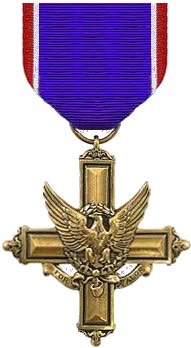 Distinguished Service Cross | Great Britain | Allies | Pilot | 15 | [13+2] (11 kills,4Lost Control,11 driven to ground) | 4 Sqn (N), 204 Sqn | RNAS & RAF | Pup, Camel ace, 1917-18. English WWI fighter ace, Albert James 'Jim' Enstone was born 25/8 1895. Enstone joined the Royal Naval Air Service on 3 April 1916 with the rank of temporary probationary flight sub-lieutenant. He learned to fly at Cranwell; seems to have showed early promise, as he was appointed as an acting flight commander during training. He graduated on 15 September 1916 with Royal Aero Club certificate 3677. Enstone was confirmed in his rank as flight sub-lieutenant on 8 November 1916; he had already been appointed an acting flight lieutenant as early as 10 April 1916. He was one of the founding members of 4 Naval Squadron in April 1917; it was stationed at Bray Dunes on the Franco-Belgian border, and was tasked with both flying offensive patrols and escorting RNAS bombing missions. He used a Sopwith Pup (below) to counter German probes over the English Channel. 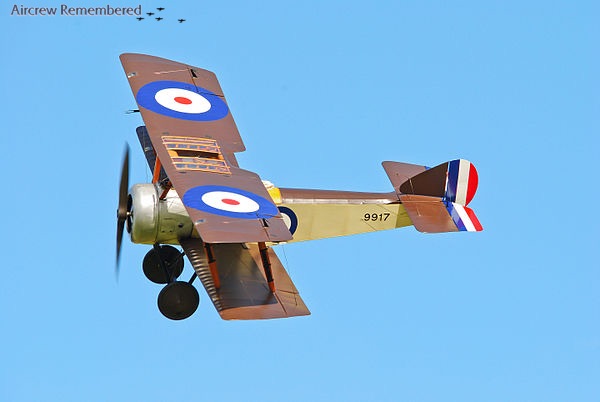 Sopwith Pup Enstone destroyed four enemy aircraft near or over the English Channel between 9 May and 5 June 1917, including one kill shared with Arnold Jacques Chadwick. His second victory, scored on 9 May, forecast his later citation for valour; Naval 4 battled a large opposing force of German Albatroses for 25 minutes, with Alexander MacDonald Shook and Langley Frank Willard Smith joining Enstone in victory. After he and his squadron upgraded to Sopwith Camels, Enstone used his new mount to down three more German aircraft in July 1917, including an effort against a seaplane teamed with Chadwick and Ronald M. Keirstead. The new ace would go on to push his victory total to 10 for 1917. Between his ninth and tenth wins, on 1 October 1917, Enstone was promoted from temporary flight sub-lieutenant to temporary flight lieutenant. He also won the Distinguished Service Cross during this string of victories. Enstone continued to win throughout the first half of 1918. When the RNAS was consolidated into the Royal Air Force on 1 April 1918, his position as flight commander automatically gained him the rank of captain. In August 1918, he was relieved of combat duty and returned to Home Establishment in England. He was awarded the Distinguished Flying Cross during this period. Citation DSC: Flight Commander Alexander MacDonald Shook RNAS Flight Lieutenant Arnold Jacques Chadwick RNAS (since reported drowned) Flight Sub-Lieutenant Albert James Enstone, R.N.A.S. Flight Sub-Lieutenant Langley Frank Willard Smith RNAS (since reported missing) For exceptional gallantry and remarkable skill and courage whilst serving with the RNAS at Dunkirk during May and June, 1917, in repeatedly attacking and destroying hostile aircraft. Citation DFC: Distinguished Flying Cross (DFC) Capt. Albert James Enstone, DSC (Sea Patrol). Has been engaged for eighteen months on active service flying (ten months as Flight Leader). Has destroyed twelve hostile machines and brought down six more out of control. During the past month Capt. Enstone attacked an enemy gun, which was firing on one of our crashed machines, and succeeded in blowing up the ammunition dump alongside the gun, causing a great explosion, with flames reaching to a height of nearly 300 feet. | Shores (Other sources 18 victories) |  |
||
| 55 | Fitz-morris | James | Capt | Great Britain | Allies | Observer | 7 | (7 with observer)(10 kills+4 Lost Control) | 11Sqn (observer), 25Sqn, 23Sqn | RFC | DH4 ace, 1917-18. | Shores | |
|||
| 56 | Fitz-morris | James | Capt | Great Britain | Allies | Pilot See Note | 14 | [13+1] (7 with observer)(10 kills+4 Lost Control) | 11Sqn (observer), 25Sqn, 23Sqn | RFC | DH4 ace, 1917-18. | Shores | |
|||
| 57 | Grant | James | Sgt | Great Britain | Allies | Observer | 8 | (6 kills+2 Lost Control) | 57Sqn (gunner) | RAF | DH4 bomber gunner, 1918. | Franks-Guest | |
|||
| 58 | Green | James Hubert Ronald | Sgt | Great Britain | Allies | Pilot 2 Seater | 6 | (2 kills+4 Lost Control) | 25Sqn | RFC | 15/12/1917 | FE2 ace, 1916-17. KIFA. | Shores. | |
||
| 59 | Hamilton | Herbert James | Capt | Great Britain | Allies | Pilot | 6 | [2+4] (1 kill+5 Lost Control) | 1Sqn, 29Sqn | RFC | 13/06/1918 | Nieuport, 1917; SE5, 1918. KIFA. | Shores | |
||
| 60 | Hardman | James Donald Innes | Capt | Great Britain | Allies | Pilot | 9 | [5+4] (4 kills+5 Lost Control) | 19Sqn | RAF | Dolphin ace, 1918. | Shores | |
|||
| 61 | Harvey | William Frederick James | Capt | Military Cross, DFC and Bar | Great Britain | Allies | Pilot 2 Seater | 26 | (3 balloons)(17 kills+9 Lost Control) | 22Sqn | RAF | Bristol Fighter ace, 1918. Some sources 25 victories) | Shores. | |
||
| 62 | Leith | James Leith | Capt | Great Britain | Allies | Pilot 2 Seater | 8 | [7+2] (3 kills+6 Lost Control) | 25Sqn RFC; 46Sqn RAF | RFC & RAF | FE2 ace, 1916-17, Camel, 1918. | Shores. | |
|||
| 63 | Latta | James Douglas | Capt | Great Britain | Allies | Pilot | 5 | (2 balloons)(3 kills+2 Lost Control) | 5Sqn, 1Sqn, 60Sqn, 66Sqn | RFC | Nieuport ace, 1916; Pup, 1917. WIA. | Shores | |
|||
| 64 | Mcdonald | James | Lt | Great Britain Scotland | Allies | Pilot | 8 | (2 kills+6 Lost Control) | 22Sqn (gunner) | RAF | Bristol Fighter gunner, 1918. | Franks-Guest (9 Shores) | |
|||
| 65 | Binnie | James Alex. Weatherhead | Lt | Great Britain Scotland | Allies | Pilot | 9 | [7+2] (with observer)(5 kills+4 Lost Control) | 48Sqn | RFC | Bristol Fighter ace, 1917. | Shores | |
|||
| 66 | Smith | James Robert | 2ndLt | Great Britain Scotland | Allies | Pilot | 5 | (2 kills+3 Lost Control) | 18Sqn (observer) | RFC | FE2b gunner ace, 1916-17. | Franks-Guest | |
|||
| 67 | Clifford | Reginald Morgan | Flt Sub Lt RNAS | Great Britan | Allies | Pilot | RNAS, RAF | Schneider Seaplane in operations against targets in Aden in 1916 Reginald Morgan Clifford was born in April 1889 and entered the Royal Naval Air Service as a Probationary Flight Sub. Lieutenant in May 1915, direct from his appointment as a Second Officer in the Mercantile Marine. Taking his Aviator’s Certificate (No. 1741) at the Grahame-White School, Hendon, that September, he joined the seaplane carrier H.M.S. Empress a few weeks later, in which capacity he remained actively employed in the Eastern Mediterranean until the end of 1916, on occasion on attachment to another seaplane carrier, the Raven II, and to No.2 Wing R.N.A.S. at Thasos. And as evidenced by official records, he undertook a number of bombing sorties against targets in Aden in the same period - thus two Schneider seaplane operations mounted from Raven II in the Red Sea on 31 March 1916, when Clifford dropped four bombs on an enemy camp near Waht - ‘there was considerable rifle and machine-gun fire at the camp and the three seaplanes that reached it were all several times hit’ - and later that day four more on the western village at Subar. In fact Clifford flew another double-sortie from Raven II the very next day, his seaplane being engaged by a gun situated between Abdurrub Bubakr and Amr Maudtha, while in the course of a reconnaissance flight from El Arish to Bir on 25 April, he ran into an enemy aircraft. His flight report takes up the story: ‘Reconnoitred North Road at a height of 2,000 feet. No movements were observed on the road. When in the vicinity of Lake Bardawil observed enemy aeroplane astern about six miles at altitude of about 5,000 feet, diving and giving chase. Altered course to seaward and kept machine down, attaining a speed of 80 knots and dropping rapidly. Enemy machine continued chase to about 15 miles out at sea, firing machine-gun (apparently mounted abaft the pilot’s seat) at intervals. When at 200 feet released bombs to lighten machine and altered course sharply in direction of ship. Enemy machine ceased fire and sheered off, steering south and climbing. His machine appeared to be a two-seater, with pilot in front; only one gun was carried which could not fire ahead. Damage to machine - one shot in chassis strut and two holes in fuselage fabric.’ The same report notes that Clifford’s sole defensive armament was ‘one Webley semi-automatic pistol.’ Invalided home from Malta with malaria in December 1916, Clifford returned to duty at East Fortune in July 1917, but ‘made a bad landing in a seaplane, bouncing on to the beach and totally wrecking the aircraft - pilot sustained severe cuts to face, legs and head’ (his service record refers), as a consequence of which he requested a transfer from seaplanes to aeroplanes. Advanced to Acting Flight Commander in February 1918, his request appears to have been accepted, since he ended the War as ‘a Camel Flight Commander’ in No. 205 (Training) Squadron back in France. Clifford was placed on the Unemployed List in July 1919 but was re-appointed as a Flying Officer in the General Duties Branch in May 1923, and attained the rank of Flight Lieutenant prior to resigning his commission in September 1924; |  |
|||||||
| 68 | Smirnoff (alt spelling Smirnov) | Ivan Vasilyevich | Capt | Croix de Guerre, Cross of St. George (when he was foot soldier), White Eagle of Siberia, Order of St. Anna, Order of St. George (equivalent to our Victoria Cross), Order of St. Stanislaus, Dutch Airman's Cross Dutch Knight of the Order of Orange-Nassau | Russia | Allies | Pilot | 11 | (1 sh. observer) | 19th Korpusnoi Aviatsionniy Otrad (19th Corps Aviation Detachment) | Imperial Russian Air Service & ML-KNIL | Born 1895-01-30 – Died1956-10-28 (some sources 1959-10-23) | Nieuport, Morane, 1917, Spad V11. Russia's 4th highest ace. Later moved to Netherlands. 1 million miles as KLM captain | Franks ( 12 Shores;12+8 unconf;13 | Not Many People Know That Archive Report |   |
| 69 | Tkachev | Vyacheslav Matveyevich | Gal | Russia | Allies | Pilot | 5 | 20AO, 1BAG | Imperial Russian Air Service & White Russian Air Force | DH9 pilot, ww1. Civil War. | Arkhipov, Abramov | |
||||
| 70 | Bagrovnikov | Ivan Mikhaylovich | Russia | Allies | Pilot | 5 | 1FAO | Imperial Russian Air Service & White Russian Air Force | ww1 and Civil War | Arkhipov, Abramov | |
|||||
| 71 | Yanchenko | Vasili Ivanovich | Ens | Russia | Allies | Pilot | 16 | 12KAO, 3KAO, 7KAO, 32KAO; 2Sqn White Army | Imperial Russian Air Service & White Russian Air Force | Nieuport, Morane, 1916-17. Civil War. | Franks (Other sources 19; 6+10 unconf) | |
||||
| 72 | Kozakov (Kazakov?) | Alexandr Alesandrovich | Kapt | Order of Saint George, Order of Saint Vladimir, Order of Saint Stanislas, Order of Saint Anne, British DSO, Military Cross, and DFC, French Legion d'Honneur and Croix De Guerre | Russia | Allies | Pilot | 20 | 4KAO, 19KAO, 1BAG; 1.Slavo-British Sqn, | Imperial Russian Air Service & White Russian Air Force | 1919-08-03 | Morane, Nieuport, 1915-17. Civil War. Top Russia ace. The first known instance of ramming in air warfare was made over Zhovkva by the Russian pilot Pyotr Nesterov on 8 September, 1914, against an Austrian plane. That incident was fatal to both parties. The second ramming—and the first successful ramming that was not fatal to the attacker—was performed in 1915 by Alexander Kazakov, a flying ace and the most successful Russian fighter pilot of World War I. Sgt Arturo Dell'Oro of the Italian 83rd Squadron rammed a two-man Br.C.1 of Flik 45 on 1 September, 1917. Wilbert Wallace White rammed a German plane on October 10, 1918. Alexander Kazakov flew on Morane-Saulnier, Spad – SА2, Nieuport 11 and Nieuport 17 planes and is alleged to have the largest number of victories over enemy aircraft among Imperial Russian Air Force pilots. Unofficially he shot down 32 German and Austro-Hungarian planes, although his official tally is only 20 because only planes crashed in Russian-held territory were counted. Russian military aviation tradition during World War I was different from that of its Western allies and rivals and the individual scores of pilots were considered to be of lesser value compared to their contribution to the overall war effort. On 31 March 1915 Alexander Kazakov successfully repeated the aerial ramming attack first attempted by Pyotr Nesterov, using a Morane-Saulnier G (below) as his piloted projectile. For this bit of daring, he was awarded the Order of Saint Anne, first in the Fourth Class, then in the Third. He was appointed to command of 19th Corps Fighter Detachment in September 1915. Here he had Nieuport 10s and Nieuport 11s to fly. Between 27 June and 21 December 1916, he racked up four more victories to become an ace.  Five months later, Kazakov resumed his winning streak with his sixth victory on 6 May 1917, which was shared with Ernst Leman and Pavel Argeyev. By 25 May, with his eighth win, he switched to a Nieuport 17, which he used henceforth.[3] Between 1915 and 1917 he fought on the Russian front as well as in Romania and participated in the Brusilov Offensive as a commander of 1st Combat Air Group. In January 1918, in the wake of the Russian Revolution, Kazakov resigned his Russian commission. | Franks (Other Sources 32; 18; 17) |  |
||
| 73 | Beane | James Dudley | 1stLt | USA | Allies | Pilot | 6 | 22ndSqn | US Air Service | 30/10/1918 | KIA. | Toliver-Constable |  |
|||
| 74 | Springs | Elliott White | Capt | USA | Allies | Pilot | 16 | (12 kills+4 Lost Control) [13+3] | 85Sqn, 148AeSqn | RAF & US Air Service | SE5, Camel ace, 1918. | Shores (12 Toliver) | |
|||
| 75 | White | Harold Albert | Lt | USA | Allies | Pilot | 7 | (3 kills+4 Lost Control) [4+3] | 23Sqn | RAF | Dolphin ace, 1918. | Shores | |
|||
| 76 | White | Wilbert Wallace Jr. | 1stLt | USA | Allies | Pilot | 8 | 147th Sqn | US Air Service | 10/10/1918 | KIA. | Toliver-Constable | |
|||
| 77 | Healy | James A. | Capt | USA | Allies | Pilot | 5 | 147th Sqn | US Air Service | Toliver-Constable | |
|||||
| 78 | Pearson | James William | Capt | USA | Allies | Pilot | 12 | (6 kills+6 Lost Control) [10+2] | 23Sqn | RAF | Dolphin ace, 1918. | Shores | |
|||
| 79 | Knowles | James Jr. | 1stLt | USA | Allies | Pilot | 5 | 95thSqn | US Air Service | Toliver-Constable | |
|||||
| 80 | Connelly | James Alexander Jr. | Lt | USA | Allies | Pilot | 7 | (1 balloon) [4+4] | SPA 157, SPA 163 FFC | Aviation Militaire Française | 02/02/1944 | Bailey & Cony (8 Porret/Toliver) |  |
|||
| 81 | Hall | James Norman | Capt | USA | Allies | Pilot | 5 | N124 FFC, 103rdAS, 94thAS | US Air Service | POW 1918. | Robertson - Tesar (Some sources 4, 6 victories) | |
||||
| 82 | Meissner | James Armand | Maj | USA | Allies | Pilot | 8 | 94thAS, 147thAS | US Air Service | Toliver-Constable (5 Bailey & Cony) | |
|||||
| 83 | Keating | James Alfred | Maj | USA | Allies | Pilot | 6 | (shared with observer) | 49Sqn (Bomber)RFC | RFC | DH9 bomber pilot, 1918. | Toliver-Constable (5 NG/FG) (Some sources 3 victories) | |
|||
| 84 | Jones | James Ira Thomas 'Taffy' | Capt | DSO and Bar, Military Cross, DFC and Bar | Wales (Great Britain) | Allies | Pilot | 37 | [35+2] (1 balloon)(30 kills+7 Lost Control) | 10Sqn, 74Sqn | RAF | SE5 ace, 1918. RAF, WWII. | Shores | |
||
| 85 | Hughes | David James | Capt | Wales (Great Britain) | Allies | Pilot | 5 | (3 kills+2 Lost Control) | 3Sqn | RAF | Camel ace, 1918. | Shores | |
Results 1 to 85 of 85.


